







Most companies communicate a lot internally. Few communicate in a way that employees actually read, remember, and act on. That gap is expensive: in Gallup's 2024 State of the Global Workplace, only 23% of employees are engaged worldwide, and disengagement tracks with higher absenteeism, turnover and quality defects. Good internal communication is one of the most direct levers to close that gap. This guide gives you 10 concrete examples of internal communication in a company, what each one is for, how to measure it, and how real companies make it work.
🧠 TL;DR: internal communication examples
- Effective internal communication rests on three things: a useful message, the right format, and a clear objective.
- The 10 examples below cover the full range: newsletter, leadership video, onboarding, change, recognition, surveys, intranet, HR moments, frontline, ambassadors.
- Each example includes how to measure it, so you can prove impact, not just send messages.
- Real companies show the payoff: Armonia cut internal emails by 80%, Bouygues rolled out two intranets in under four months.
- The right move is not to do all ten, but to pick the right lever at the right time on a solid intranet foundation.
What makes a good example of internal communication?
Before copying an example, it helps to know what separates truly useful internal communication from a message that just adds noise. Many companies broadcast; few inform clearly, mobilize durably, and create buy-in. A good example does three things well.
A useful message. It gives the employee something valuable: it helps them understand a decision, do their job better, find their way, or embrace a change. It answers the only question the reader really has, "How does this concern me?", and gets to the point instead of talking about the sender.
A suitable format. The format fits the message, the context and the audience. A strategic announcement lands very differently buried in a long email versus delivered in a short leadership video or on a well-structured intranet. Information for frontline teams cannot be designed like a message for office workers.
A clear objective. Every good example is built on a specific goal: to inform, reassure, unite, support a change, recognize a team, drive adoption, or gather feedback. When the objective is clear, everything downstream gets easier, the words, the tone, the channel, the timing, and the way you measure results.
Keep those three criteria in mind: a useful message, a suitable format, a clear objective.
Summary table of the 10 internal communication examples
Example 1: the weekly internal newsletter
The weekly internal newsletter is still one of the most effective examples of internal communication in a company. It creates a regular appointment with information and stops messages from scattering across inboxes and chats. Used well, it aligns teams, structures the news, and reinforces consistency, especially when it stays short and gets to the point. If it turns long, top-down or institutional, it loses its readers fast.

A good internal newsletter highlights the genuinely useful information, is easy to scan, encourages a click to learn more, and redirects to a central space such as the intranet.
How to measure it: open rate, click-through rate on the linked content, and the share of readers who act on a call to action. A newsletter that is opened but never clicked is telling you the content is not useful enough.
In practice: the outsourced-services group Armonia rebuilt its internal communication around a Microsoft 365 intranet enriched by Jint and cut internal emails by 80%, with around 500 daily logins and twice the content views. The newsletter became a gateway to the intranet rather than one more email in an overloaded inbox.
Good to know: an internal newsletter works far better when it is not isolated. Use it as a gateway to a central space where employees find news, resources and next steps. It improves clarity and multiplies the impact of your messages.
Example 2: the leadership video message
The video message from leadership is an excellent example of effective internal communication when the point is to carry an important message. Where an email can feel impersonal or overly formal, video conveys intention, tone and vision. Its real advantage is weight: employees do not just read information, they see who is speaking, how, and in what state of mind. That changes how the message is received.
To work, it has to stay simple: get to the point, use a light and natural tone, sound sincere rather than over-scripted, and go out on the right channel at the right moment.
How to measure it: number of views, average watch time (do people finish it?), and sentiment in the leadership-trust questions of your engagement survey. A spike in views with low watch time means the hook works but the content does not.
Example 3: the onboarding journey for new hires
The onboarding journey is a high-stakes example of internal communication because it shapes the employee's first impression. From day one, the quality of the messages a new hire receives influences how they understand their role, how quickly they feel they belong, and how fast they become productive. A well-integrated employee becomes autonomous, confident and engaged faster; a vague onboarding creates confusion from the start.
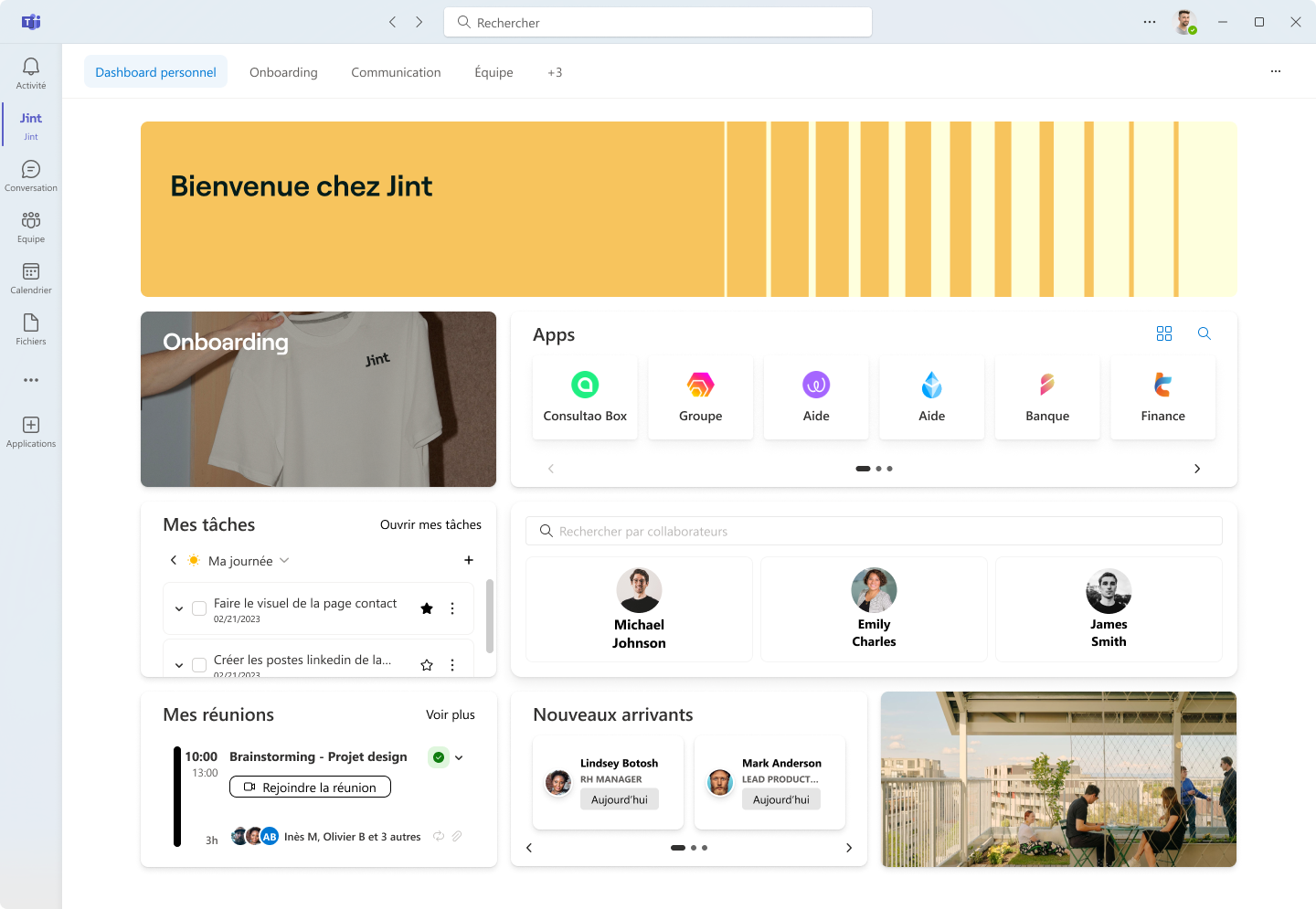
To be effective, onboarding communication should deliver the right information at the right time, stay simple and progressive, mix practical content with cultural messages, and point to a central space.
How to measure it: time-to-productivity, completion of onboarding steps, and retention at 90 days. For instance, many companies now rebuild onboarding around short video sequences to cut content-production time and keep the experience consistent across locations.
Example 4: communication around an organizational change
Communication around organizational change is one of the most sensitive examples of internal communication in a company. Whether it is a team merger, a new management structure, a reorganization or an evolution of roles, the way you communicate becomes as important as the change itself. Silence and vague messages breed uncertainty; clear communication eases the transition, reduces misunderstandings and protects trust. Employees do not just want an announcement, they want to understand what is changing, why, and what it means for them concretely.
To be effective, change communication should explain the change in plain words, answer the teams' real questions, stay consistent over time, and open spaces to listen to reactions.
How to measure it: pre- and post-change understanding surveys, adoption of the new process, and the volume of questions or concerns raised (a healthy sign that people feel safe to ask). Industrial group RHI Magnesita, for example, is often cited for running its post-merger change communication through a multilingual mobile app to keep 14,000 employees, most of them plant workers, aligned across languages.
Example 5: recognizing team success
Highlighting a successful project, an achieved objective or a strong collaboration gives visibility to the work done and reinforces recognition. Done sincerely, it fuels motivation, pride and cohesion, and reminds employees that their contribution matters. Done in a stiff, over-formatted tone, it falls flat.
To be effective, this communication should spotlight concrete, useful successes, value teams sincerely, explain why the success deserves to be shared, and avoid corporate stiffness.
How to measure it: reactions and comments on the recognition post, participation in nominations, and the recognition-related items in your engagement survey or eNPS. If you want the deeper play, see how to build a strong corporate culture.
Example 6: internal surveys and feedback collection
Internal surveys and feedback collection are excellent examples of internal communication because they remind us that good communication is not only broadcasting, it is listening. When a company gives employees a voice, it shows it wants to understand the reality on the ground. But the value does not come from the survey itself, it comes from what you do with it. Feedback that vanishes with no visible follow-up creates disappointment; feedback that is acted on builds trust.
To be effective, this approach should ask clear, useful questions, stay simple to encourage participation, share the key lessons, and show the actions taken as a result.
How to measure it: response rate, response rate over time (is it rising or falling?), and, above all, the number of feedback items that led to a visible action. The real lever is linking listening to measurement: the more you connect the two, the more credible and manageable your internal communication becomes.
Example 7: the intranet as the central communication hub
An intranet is one of the strongest examples of internal communication in a company when it becomes the natural entry point to information. Instead of scattering messages across tools, it centralizes content, structures conversations, and gives employees a clear reference point. That is what makes it strategic: a good intranet improves readability, reduces information loss, and supports more consistent communication across the whole company. It can even become a real engagement driver when teams feel better informed and better connected.
To be effective, an intranet should centralize important content in a clear space, make useful information quick to reach, target messages by audience, and drive adoption with a simple experience.
How to measure it: active logins, internal searches (and their success rate), and content views per employee. When Bouygues, one of the largest construction and services groups with more than 200,000 employees, needed to modernize its digital workplace, it rolled out two intranets in under four months on Microsoft 365 with Jint, a scale and speed that a from-scratch build rarely matches.
Want to turn SharePoint into a real internal communication hub? See how Jint for SharePoint works.

Good to know: an intranet becomes genuinely useful when it does more than store information. It should connect your everyday tools, simplify access to key content, and guide employees to the right resource at the right time. That is often the difference between a platform nobody opens and a real internal communication channel.
Example 8: internal communication during a key HR moment
Internal communication during key HR moments is an excellent example because it gives visibility to the moments that matter most to employees. Annual review campaigns, the launch of a training program, a quality-of-life-at-work week, or a benefits communication all need a clear frame to be understood and followed. Without structured communication, these initiatives go unnoticed or get misread. With it, you explain the objective, show the value, and prompt action, turning an HR initiative into a motivating communication opportunity.
To be effective, this communication should explain the moment and its significance, specify the expected actions, use several relays, and stay consistent before, during and after the campaign.
How to measure it: campaign reach, participation or sign-up rate, and completion of the expected action (reviews submitted, sessions booked, benefits enrolled).
Example 9: local communication for frontline teams
Local communication for frontline teams is a crucial, and often poorly handled, example of internal communication in a company. In many organizations, messages are designed at headquarters and pushed out uniformly, but realities on the ground differ by site, role and constraint. This matters most in multi-site companies, industry, retail, logistics, and anywhere employees are not in front of a computer all day. Done well, it improves understanding, strengthens inclusion, and keeps information flowing across the company.
To be effective, it should adapt messages to field constraints, rely on trusted local relays, use genuinely accessible formats, and stay connected to the company's overall communication.
How to measure it: mobile reach (how many frontline workers actually receive the message), read rate on the app, and participation from non-desk sites. The City of Westmount in Canada, for example, uses a Microsoft 365 intranet extended by Jint to reach office and field agents on mobile.
Good to know: for field teams, the channel matters as much as the message. Local communication is always more effective when it is mobile-friendly, easy to reach on the ground, and adapted to your employees' languages. The simpler the access, the more likely the information is actually read.
Example 10: internal ambassadors
Internal ambassadors are an excellent example of effective internal communication because they relay messages in a more human and credible way. Instead of relying on a single team or top-down broadcasting, the company leans on identified employees to circulate information, build relationships and foster buy-in. Their strength is that they do not just speak on behalf of the company, they embody the reality on the ground, which makes their messages more concrete and better received.
To be effective, this approach should rely on legitimate, voluntary profiles, clarify their role, give them the right content at the right time, and keep the program alive over time.
How to measure it: number of shares, reach of employee-relayed content, and its engagement versus official channels. The payoff is real: according to PostBeyond, a message relayed by employees can travel up to 561% further than the same message from brand channels, because personal networks carry more reach and more trust than a corporate account.
How to adapt these examples to your business
There is no universal recipe. The right examples depend on your size, structure and priorities. Use this table to match the levers to your context.
The foundation behind every example: a structured intranet
Notice what nine of these ten examples have in common: they work far better on top of a single, well-governed space. A newsletter that links to the intranet, onboarding that lives there, recognition that surfaces on the social wall, frontline messages pushed to mobile, all of it depends on one structured foundation rather than a pile of disconnected tools. That is where Jint sits on Microsoft 365: it turns SharePoint into a real internal communication hub, with audience-targeted news, a social wall to fuel ambassadors, and a mobile reach for frontline teams.
There is also a forward-looking reason to get this right. As Microsoft Copilot and AI assistants like Jint Genius spread, they are only as good as the information they can reach. A structured, up-to-date intranet is what lets an AI assistant answer accurately instead of surfacing stale or contradictory content. Put the foundation in place first, and every example above gets easier, and future-proof.
Final thoughts
The best internal communication is not about doing all ten of these at once. It is about choosing the right lever at the right time, giving each a clear objective, and measuring whether it actually informs, engages and moves people to act. Start with the two or three examples that fit your context, put them on a solid intranet foundation, and build from there. Book a demo to see how Jint helps companies turn these examples into a working internal communication system.
.jpg)


