







🧠 TL;DR: the social intranet
- A social intranet adds conversation and community to the classic intranet.
- Its key features: social feed, communities, comments, reactions, recognition.
- It shifts from top-down communication to two-way exchanges.
- On Microsoft 365, it builds on Viva Engage and the intranet's social features.
- A social intranet helps distribute information, spark exchanges, strengthen connections and engage employees.
- Its key features include an engaging news feed, communities to bring employees together, social interactions, rich profiles, and easy content and knowledge sharing.
- Its real value lies in making internal communication more dynamic, collaboration more fluid and the employee experience more engaging.
- To be effective, a social intranet must address real use cases, be easy to adopt and fit naturally into the daily flow of work.
Management sets the tone: according to Gallup (2024), managers account for 70% of the variance in team engagement.
What is a social intranet?
| Criteria | Classic intranet | Collaborative intranet | Social intranet |
|---|---|---|---|
| Main purpose | Centralise internal information | Facilitate teamwork | Inform, connect and engage employees |
| Communication type | Mainly top-down | Functional and project-oriented | Interactive, participative and community-driven |
| Interaction level | Low | Moderate | High |
| Main uses | News, documents, resource access | Co-editing, file sharing, coordination | News feed, communities, exchanges, expertise sharing |
| Employee role | Reader | Operational contributor | Actor, contributor and participant |
| Key benefit | Better information distribution | Better collaboration | Better communication, cohesion and knowledge sharing |
| Effect on engagement | Limited | Varies by usage | Strong, if adoption and animation follow |
| User experience | Often static | Useful but production-focused | More lively, relational and engaging |
Definition of a social intranet
A social intranet is an internal digital space that allows your employees to stay informed, interact, share, and participate within a single environment. Whereas a traditional intranet primarily disseminates top-down content, a social intranet introduces a much more dynamic dimension, transforming internal communication into conversation and information into engagement.
In practical terms, this means creating a space where teams can react, comment, exchange ideas, join communities, identify the right contacts, and facilitate the flow of knowledge. In this sense, the social intranet becomes a real lever for bringing employees closer together, strengthening company culture, and streamlining daily collaboration.
How does a social intranet differ from a traditional intranet?
A traditional intranet primarily follows a publishing logic : the company informs, employees consult. The flow is mainly top-down.
The social intranet, on the other hand, is based on a much more interactive approach . Employees are no longer simply readers. They can become participants, contributors, information relays, and active members of internal communities. This evolution changes everything, as it gives more space to exchange, showcases expertise, and fosters team participation.
A traditional intranet can serve a useful function as an internal portal. However, it quickly reaches its limits when your goal is to foster engagement, break down silos between teams, or create more personal internal communication. Conversely, a social intranet supports a collective dynamic : it makes information more accessible, interactions more natural, and collaboration smoother.
What are the differences between intranet, collaborative intranet and social intranet?
- The intranet is mainly used to centralize internal information: news, documents, HR resources, procedures, directory or access to tools.
- The collaborative intranet goes further by facilitating teamwork: co-editing, file sharing, project spaces, coordination between teams.
- The social intranet adds a layer of human interaction : comments, reactions, communities, enriched profiles, conversations and networking between colleagues.
In other words, the intranet lays the foundation, the collaborative intranet improves teamwork, and the social intranet strengthens connections, participation, and engagement. In practice, the best platforms often combine these three dimensions. But if you want to create a more modern, unifying, and useful daily experience, the social dimension becomes a decisive factor .
Good to know : If you already use Microsoft 365, you don't need to start from scratch to create a more social intranet. Jint presents its solution as a set of ready-to-use components, deployed as Microsoft 365 add-ins and easy to integrate, without requiring extensive custom development.
What are the essential social features of a social intranet?
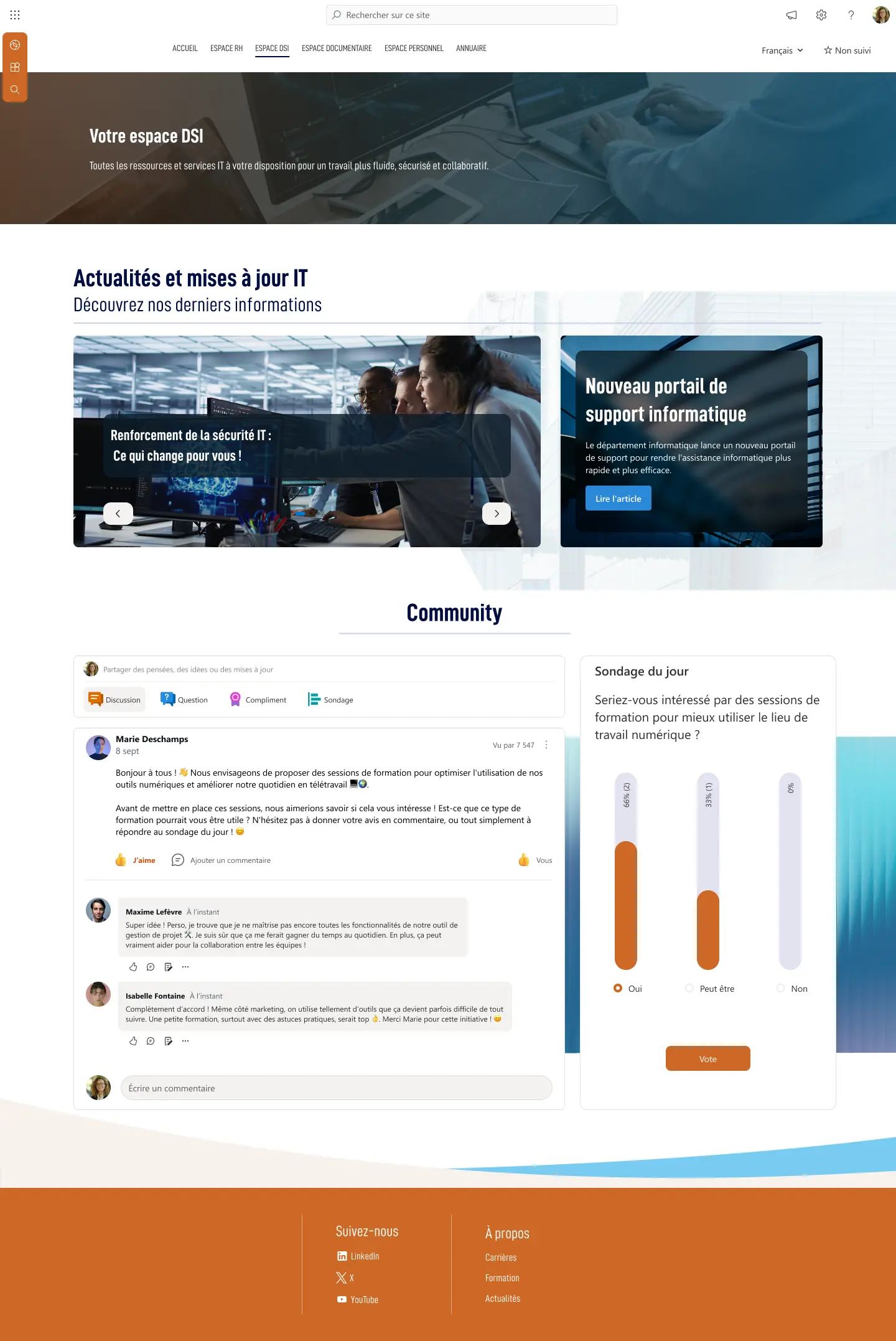
A social intranet is useful in its ability to circulate information, create interactions and bring employees closer together .
The news feed for sharing information and fostering internal communication
The news feed immediately sets the tone for your social intranet. If it's clear, dynamic, and well-structured, it captures attention and encourages users to return. If it's confusing or static, the tool quickly loses its perceived value.
Its role is to make information visible without requiring employees to search for it everywhere. Internal news, strategic messages, team initiatives, events, important updates… everything can converge in a central, readable and dynamic space.
A good news feed also creates momentum. It helps to pace internal communication, highlight priority topics, and give more visibility to important statements.
Communities and exchange groups to bring employees together
A social intranet should allow employees to connect around a shared profession, project, site, interest, or common challenge. Communities and discussion groups create these meeting points . They structure discussions and prevent everything from getting lost in email chains, isolated conversations, or scattered tools.
Exchanges become smoother, more visible, and more useful. You facilitate the flow of ideas, bring together teams that rarely work together, and provide a framework for interactions that would otherwise remain informal or fragmented.
It is also an excellent lever for cohesion . In hybrid or multi-site organizations, these spaces help to maintain connections and foster a shared culture, even remotely.
Reactions, comments, and conversations to stimulate interaction
Reactions, comments, and conversations give employees the opportunity to express themselves, respond to information, ask questions, or highlight initiatives. These may seem like small mechanisms, but in reality, they profoundly change the relationship between the company and its teams.
News without interaction remains top-down. News that is commented on becomes an exchange . And this exchange has enormous value; it makes communication more personal, more credible, and often more useful.
Employee profiles, directory, and networking opportunities for colleagues
Who is familiar with this topic? Who is already working on this project? Who can respond quickly? Without visibility on the people involved, information circulates poorly and exchanges take time.
This is where enriched profiles and the directory become truly important. They allow you to go far beyond a simple internal directory. You make visible the roles, expertise, teams, skills, and sometimes even the topics worked on by each employee.
The right people are found faster, connections are made more naturally, and collaboration becomes smoother. In a complex organization, it's a real accelerator.
Good to know: If your priority is helping employees quickly find the right person to talk to, Jint offers features like organizational charts and dynamic photo directories. The goal: to search for someone by name, department, job title, or skill, and then contact them more easily.
Sharing content, resources and knowledge within the company
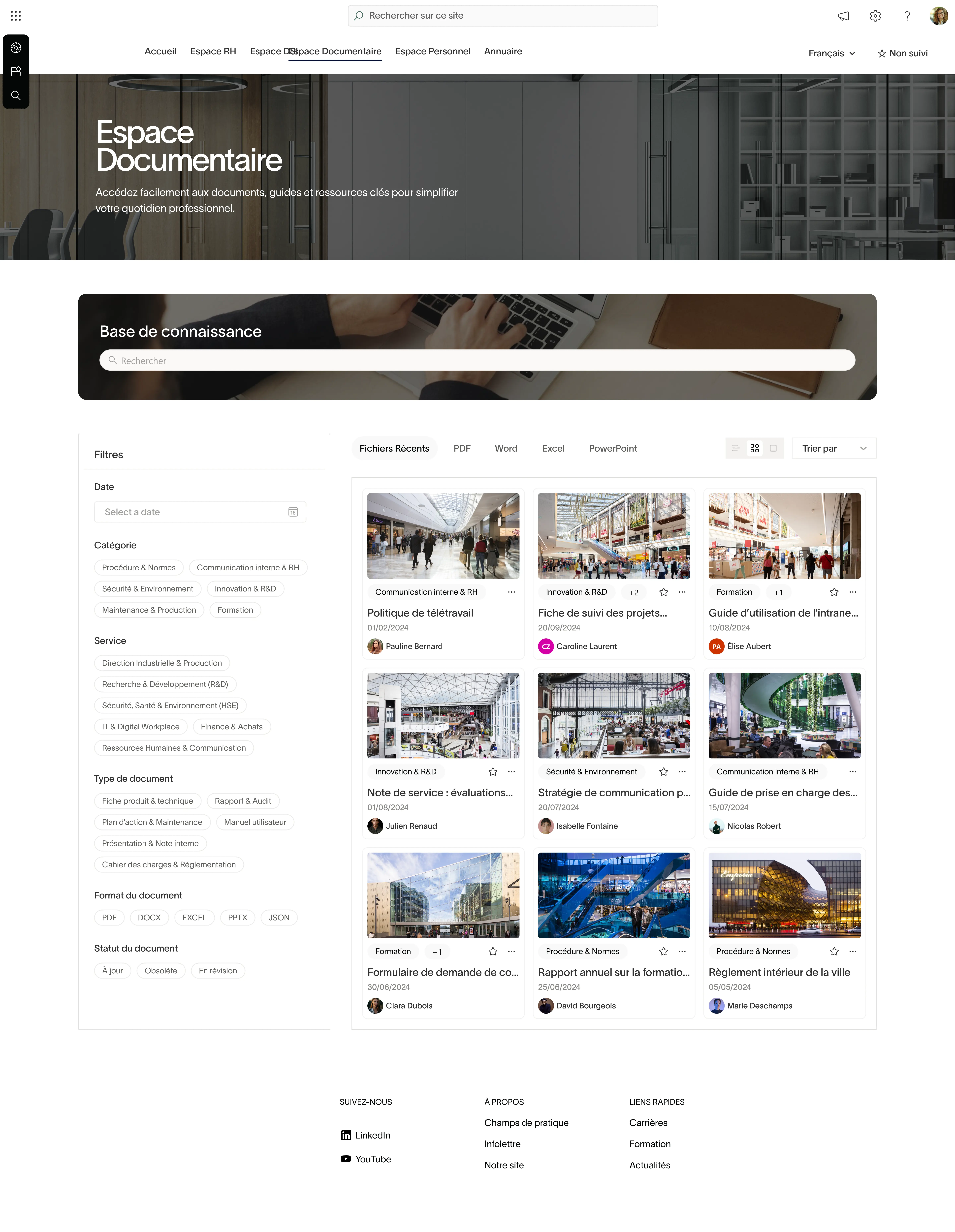
A well-designed social intranet facilitates content sharing, the dissemination of useful resources, and the showcasing of internal knowledge. It's not simply about storing information, but about making it accessible, visible, and actionable at the right time.
This is a significant change. You are moving from an archiving approach to a transmission approach . And this difference has a direct impact on collective efficiency because there is less wasted time, more continuity, and better utilization of the expertise already present within the company.
5 use cases for a social intranet in a company
- Inform employees and create more dynamic internal communication
In many companies, the information exists. The real problem is that it arrives poorly, too late, or without impact.
A social intranet provides a more readable framework for internal communication and offers a single entry point to find news, important announcements, management messages, internal events or useful daily information.
Instead of top-down communication, which can sometimes be impersonal or disjointed, you create a more dynamic communication. News is visible, contributions are better valued, and employees can react, comment, or share information.
- Enhancing the employee experience, from onboarding to daily engagement
The employee experience is also built in the details of everyday life such as access to information, ease of finding the right contact, the feeling of being included, the clarity of messages, and the quality of internal interactions.
From the very beginning of onboarding, it helps newcomers understand the organization, identify the right contacts, access useful resources, and quickly become familiar with the company culture. Integration becomes simpler, smoother, and above all, more reassuring.
Furthermore, over time, the social intranet supports engagement. It gives visibility to internal initiatives, values teams, makes communication more accessible, and helps create a more human digital environment.
- Promote exchanges and collaboration between teams, professions and sites
Silos remain one of the most frequent obstacles in business. Teams work, progress, and produce… but often within their own boundaries. Information flows poorly between departments. Good ideas remain localized. And useful connections fail to materialize.
Thanks to communities, exchange groups, collaborator profiles, and discussion spaces, it becomes easier to connect people beyond the organizational chart. Teams located at different sites can share best practices. Roles that rarely collaborate can gain better understanding. Cross-functional projects can run more smoothly.
- Sharing knowledge and promoting internal expertise
In many organizations, the knowledge already exists. It is simply scattered, not very visible, or difficult to mobilize at the right time.
A social intranet helps to better structure this flow of knowledge . Resources become easier to share, useful content rises more naturally, internal expertise is more visible, and employees know more quickly where to find an answer, a document, or a contact person.
But the issue goes beyond simply providing access to information. It's also about showcasing the company's expertise. When an employee shares a best practice, publishes feedback, or contributes to a professional discussion, they enrich collective intelligence. The social intranet creates the conditions to ensure that this value doesn't remain isolated.
- Encourage participation, listening, and collective innovation
Finally, a social intranet can become a real driver of participation .
Provided, of course, that it is not reduced to a simple publishing space.
When well-managed, it offers employees the opportunity to react, propose ideas, share feedback from the field, raise a need, or contribute to collective thinking. This dynamic is invaluable because it creates a more open and engaging culture . Teams are no longer simply passive recipients of communication; they can actively participate in it.
For the company, the benefit is twofold. On the one hand, you improve internal communication and gather useful feedback. On the other hand, you stimulate everyday innovation, the kind that often arises from real-world practices, specific pain points, and close interaction with the field.
Discover the best SharePoint intranets for business services
Get inspired by real-world examples to build a social intranet that's effective, engaging and tailored to your teams.
How to launch the social layer without it backfiring?
Opening up social features is not enough: without animation, a feed stays empty and undermines the intranet. Start with a few high-value communities (trades, mutual help, company life), hand their animation to willing champions and lead by example from management. Frame usage with a simple charter to avoid drift. A successful social intranet is not the one with the most features, but the one where exchanges are regularly nurtured and valued.
.jpg)


