





.avif)

🧠 TL;DR: the intranet for finance
- The finance function needs an intranet to make access to information and procedures reliable.
- Without one: scattered documents, multiple versions, email dependency.
- Key features: governed document base, search, workflows, security.
- On Microsoft 365, the finance intranet stays in the tenant, secure and compliant.
The hidden cost is search time: according to McKinsey (The Social Economy), employees spend on average 1.8 hours a day searching for and gathering information.
TL;DR
A finance intranet centralizes sensitive data, secures access, and reduces time wasted searching for information. It improves the distribution of procedures, strengthens consistency across practices, and streamlines collaboration between teams (finance, HR, IT, legal).
Without an intranet, documents are scattered, rules are inconsistently applied, and coordination slows down. With a structured intranet, the finance department gains efficiency, stronger governance, and better control over operations.
Key features include: document management with version control, centralized access, smart search, access rights management, internal communication, and cross-functional collaboration.
Why the finance department needs an intranet today
Securing the flow of sensitive financial data
Finance handles information daily that tolerates neither improvisation nor approximations. Budgets, management data, audit documents, internal procedures, compliance elements, reports, closing documents, these are sensitive, sometimes critical, and always structuring contents.
However, in many organizations, this information still circulates between several spaces. A shared folder here, an attachment there, an older version found in a Teams channel or in an email inbox. Nothing is truly centralized . And above all, nothing is fully controlled.
A well-structured intranet makes an immediate difference. It creates a more reliable access point for sensitive content, with consistent classification, governance, and distribution logic. You reduce gray areas. You reassure teams. And you strengthen trust in the information used daily.
Accelerating access to useful information in a constrained environment
Finance operates within a demanding and highly regulated framework. Deadlines are tight, approvals follow one after another, dependencies between teams are numerous, and every delay can have a cascading effect on the rest of the organization.
In this context, wasting time searching for the right procedure, the right model, the latest version of a repository or a reporting document is never insignificant.
It is often one of the most underestimated obstacles in the finance function.
The information exists. But it's sometimes poorly named, poorly organized, buried in too many spaces, or simply difficult to find when needed. As a result, your teams interrupt their tasks, ask other colleagues for help, and repeat searches they've already done.
A finance intranet provides a very concrete benefit here because it reduces the time wasted within the finance team between the moment when information is needed and the moment when it actually becomes accessible.
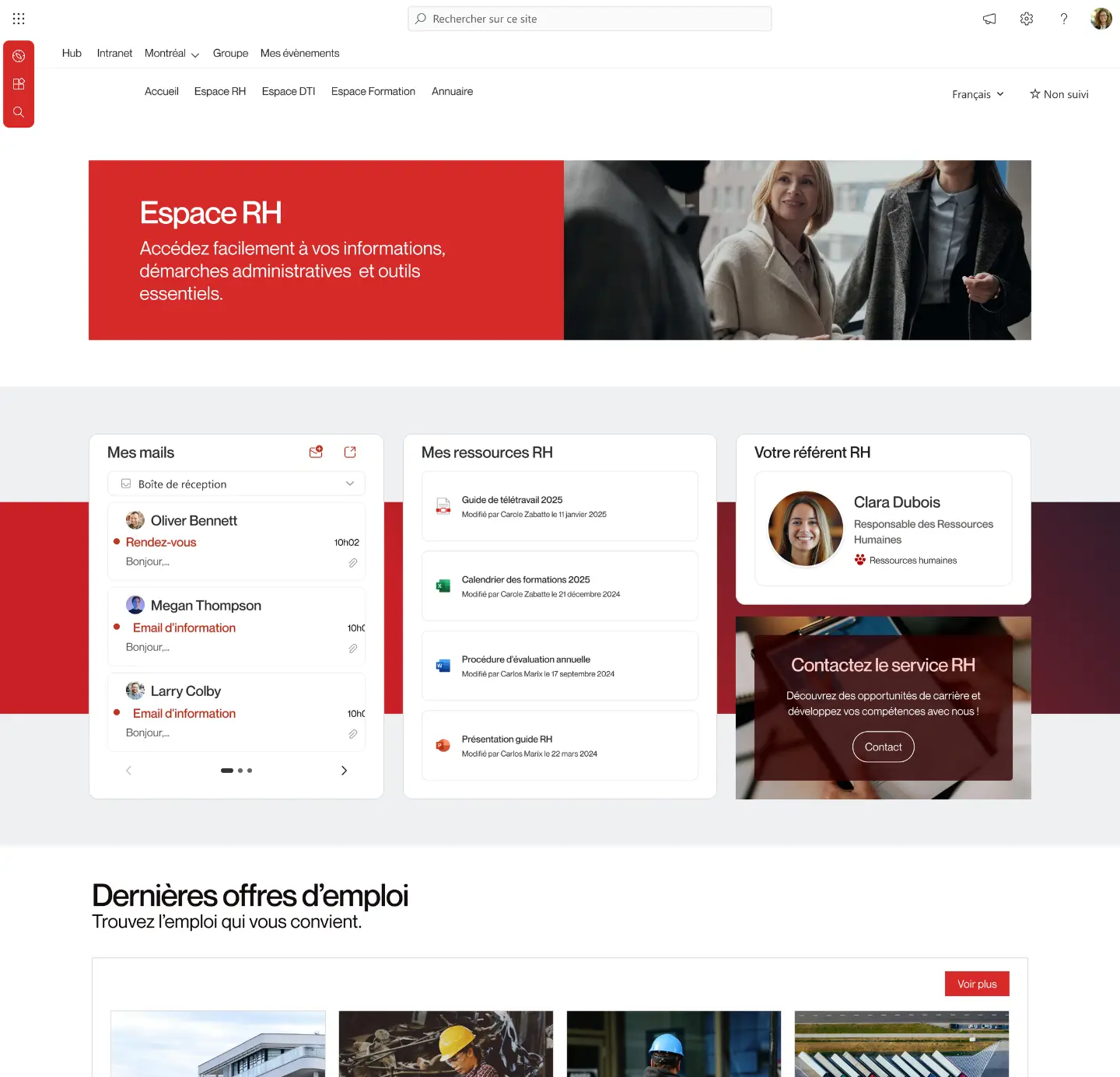
Good to know : With Jint SharePoint, access to information can be made much smoother thanks to a clearer experience and components designed to quickly bring important content to the forefront. For a finance department, this means more direct access to procedures, reports, and repositories without constantly relying on the right people to intervene.
Better integration of internal communication, operational execution and governance
The finance department creates rules, provides guidance, formalizes procedures, and regulates practices that directly impact the company's operations . But for governance to be truly effective, its mere existence is not enough. It must also be disseminated, understood, and implemented.
An intranet makes it possible to connect what too often remains separate, such as internal communication, operational execution, and governance .
The finance department can use it to publish clear messages, provide the right resources, structure access to management rules, and give teams a common framework . Everything becomes clearer, more consistent, and more actionable.
The friction points of the finance function without an intranet
Financial documents scattered across multiple tools and spaces
A reporting template in a shared folder, a procedure in SharePoint, a scoping note sent by email, an internal control document stored in Teams, an older version kept "just in case" on a local drive. Each element exists. But the whole thing lacks coherence .
In such an environment, finding the right information becomes a task in itself . And the more reporting cycles, validations, and regulatory documents the finance function manages, the more costly this lack of centralization becomes.
An intranet addresses this structural weakness precisely . It provides a clear location for the content that should serve as a reference.

Uneven dissemination of procedures, management rules and internal guidelines
Finance is particularly exposed to this problem. It formalizes internal standards, control principles, closing procedures, management frameworks, and validation guidelines that must be understood and applied consistently .
Some teams are following the latest procedure. Others are continuing with an older approach. Some have access to the correct documentation. Others are still working with incomplete resources. Little by little, collective cohesion is fracturing .
Without an intranet, information dissemination too often depends on intermediaries, local habits, or the goodwill of teams. With a structured space, the finance department can, on the contrary, make rules more visible, more accessible, and easier to apply .
Slower coordination between finance, HR, IT, purchasing and legal
Finance depends on constant interactions with other functions such as HR for payroll-related elements, IT for tools and access, purchasing for commitments and contractual documentation, or legal for compliance frameworks and sensitive approvals.
In the most critical moments (closing, auditing, updating a procedure, regulatory changes, internal reorganization), slowness is costly . It creates delays, roadblocks, and sometimes misunderstandings between teams that should be working on a common basis.
A well-designed intranet streamlines these interactions. It doesn't replace human collaboration, but it provides a more stable foundation . Support functions and finance teams have easier access to the same resources, documents, and messages. And that makes a big difference: less back-and-forth communication, less ambiguity, and greater collective efficiency.
The 7 essential features of a finance intranet
| Topic | Without a structured intranet | With a finance intranet |
|---|---|---|
| Access to procedures | Teams search across multiple tools and often rely on colleagues | Procedures are centralized and accessible from a single entry point |
| Version management | Multiple versions circulate, reducing document reliability | A single reference version is clearly identified and better controlled |
| Sensitive documents | Content is scattered, with unclear visibility over access rights | Access rights and confidentiality are better managed |
| Reporting and frameworks | Information exists but is difficult to quickly locate | Financial reports and frameworks are available in a structured space |
| Distribution of internal rules | Guidelines and procedures are not always applied consistently | Management rules and internal policies are better communicated |
| Cross-functional collaboration | Interactions between finance, HR, IT, procurement, and legal take more time | Teams share a common base and collaborate more efficiently |
| Audit and compliance | It is often necessary to reconstruct history or locate the right documents | Traceability, access to reference content, and auditability are strengthened |
1. Secure document management with version control
Document management adapted to finance should allow for clear organization of content, limiting duplicates, tracking of changes, and unambiguously identifying the reference version .
This is particularly important for procedures, closing documents, audit documents, reports, control matrices, or internal repositories.
2. Centralized access to procedures, reports and financial reference data
A high-performing intranet provides a clear access point to closing procedures, management rules, reporting, templates, financial reference data, and resources used daily by teams.
The benefit is twofold.
On the one hand, you reduce time wasted searching . On the other hand, you standardize practices further, because everyone starts from the same base. This strengthens both employee autonomy and consistency in execution.
3. Structuring of internal policies and regulatory requirements
A good intranet structures content. It gives it a logical location, a readable hierarchy, and visibility tailored to its importance. This organization transforms theoretical documentation into a truly effective tool .
This point is crucial because in finance, a useful rule is not just a well-written rule. It's a rule that teams can find, understand, and use at the right time .
Good to know: If you want your procedures, internal policies, and financial frameworks to remain consistent over time, the issue isn't just about the content; you also need to structure the format. With page templates and simplified contribution, Jint helps you publish more consistent, readable, and easier-to-maintain content.
4. Intelligent search to quickly find the right information
In finance, teams don't have time to navigate through multiple levels of the hierarchy to retrieve a procedure, rule, template, or reference document. They need fast, accurate, and reliable access . And they need it when the pressure is highest.
Intelligent search helps reduce this friction . It helps employees identify the right content more quickly, even when they don't know its exact location. It improves autonomy, limits unnecessary internal requests, and shortens the time between needing information and actually using it.
5. Fine-grained management of access rights and content confidentiality
A well-designed intranet allows the finance department to disseminate information within a structured and secure framework, ensuring the right document is accessible to the right person. Each user profile, from the CEO to HR, purchasing, or operations teams, has the level of visibility tailored to their needs. You better protect sensitive data while making truly useful information easily accessible to your internal clients.
6. Downward communication from the finance department
When well-designed, an intranet allows the finance department to speak with a clearer, more structured, and more consistent voice . It gives teams more direct access to the information that guides their work, without relying solely on managerial channels or informal sharing.
The more clearly the financial management communicates, the more consistent the execution becomes .
Good to know : Financial communication is only useful if it's actually seen. With Jint, SharePoint content can also be shared in Teams, making it easier to distribute news, procedure updates, or messages from the finance department within the environment already used by teams.
7. Cross-functional collaboration on key financial processes
An effective finance intranet creates common reference points, makes documents more accessible, clarifies shared references, and allows teams to interact on a more stable basis. This reduces unnecessary back-and-forth communication, misunderstandings, and excessive reliance on informal channels.
The result is very concrete because processes move forward more cleanly, validations are better prepared, and finance more easily regains its ability to steer rather than suffer the frictions of daily life.
Key takeaways
- Centralize sensitive financial data in a single, reliable space
- Secure access with clear governance and permission controls
- Reduce time wasted searching for documents and procedures
- Ensure consistent application of financial rules and processes
- Improve collaboration between finance and other departments
- Strengthen internal communication from the finance leadership
- Boost overall efficiency and operational control
.jpg)


