



.webp)
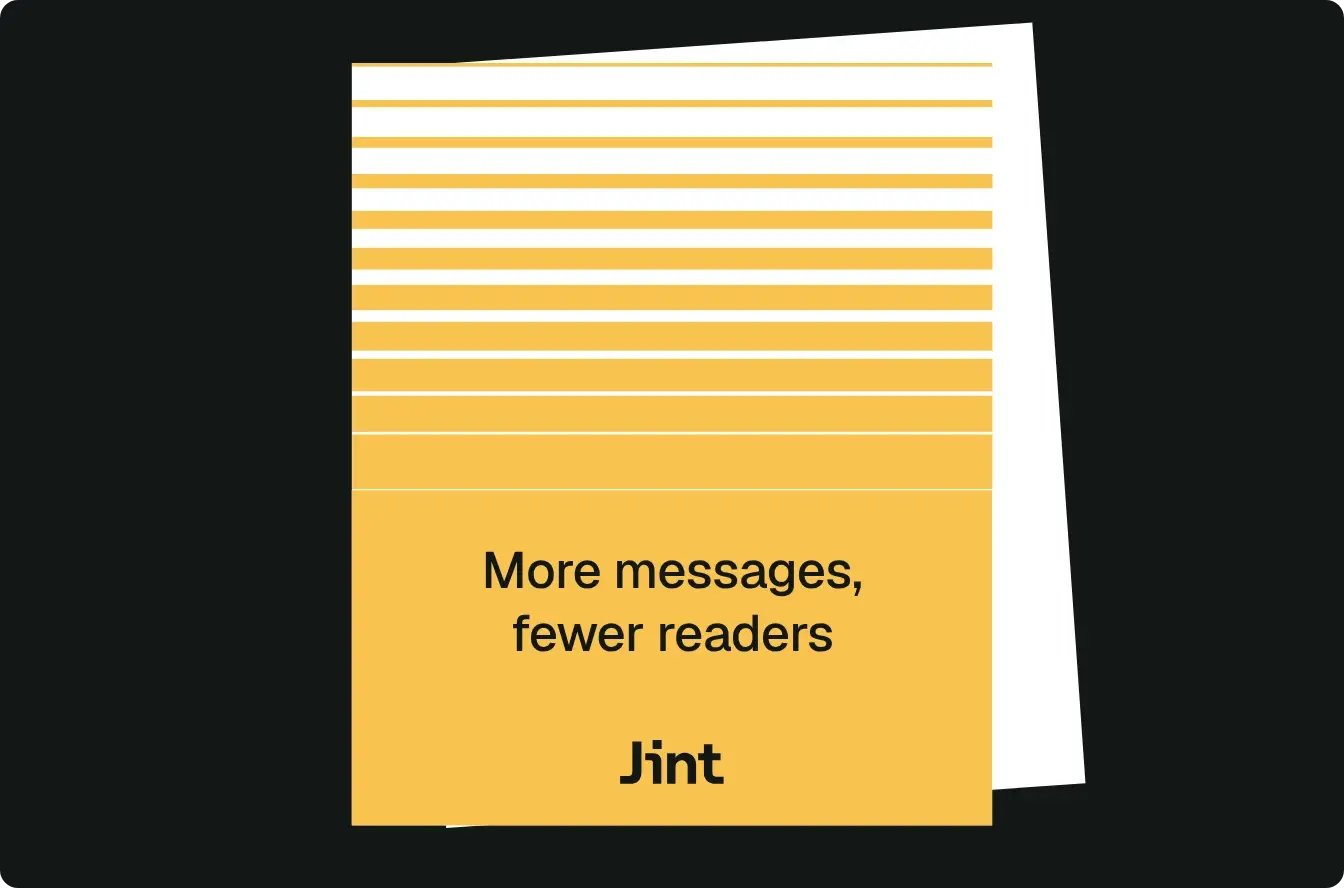
How do you get internal messages read when employees already receive too many?
Your employees are not short of messages. They are short of cues to know which ones to read. An employee receives 117 emails a day, and most of them are skimmed in under a minute (Microsoft, 2025).
Writing more will not get you read more. Worldwide, 20% of employees were engaged in 2025, the lowest level since 2020 (Gallup, 2026). This guide provides a charter, a matrix and a dashboard to bring order to your channels.
What's inside this guide:
- The diagnosis: why one more channel adds noise rather than readers, and why the most read channel is not always the most trusted.
- A role for each of your 7 channels: the strength, limit and natural audience of email, Teams, the intranet, the newsletter, mobile, displays and managers, then a charter that fits on one page.
- One primary channel, two relays at most: a matrix by message type and an access channel for each population, from office staff to employees without a fixed workstation.
- A campaign in four steps: the announcement, the manager relay, the targeted reminder and the proof, applied to three illustrative scenarios.
- Measure who is informed: ten indicators of distribution, reach and effect, along with what Microsoft 365 analytics already measure and their limits.
- A 180-day roadmap: the charter signed on day 30, the matrix and a pilot campaign on day 90, the dashboard and the review on day 180.
- Three tools to print: the channel charter template, the reach dashboard and three checklists, including the manager kit.
Why download it:
A simple rule for every message. A primary channel carries the full version, and one or two relays point to it. A single version is authoritative, and there is one place to count readers.
Managers informed before their teams. Managers receive the kit 48 hours before the announcement, with the message in three sentences and answers to the expected questions.
A measure of what reaches employees. The ten indicators focus on readers, population by population, rather than on the number of sends.
An approach that needs no new tool. The charter, the matrix and the dashboard can be put in place in 180 days, even with a communications team of fewer than six people.


