.webp)

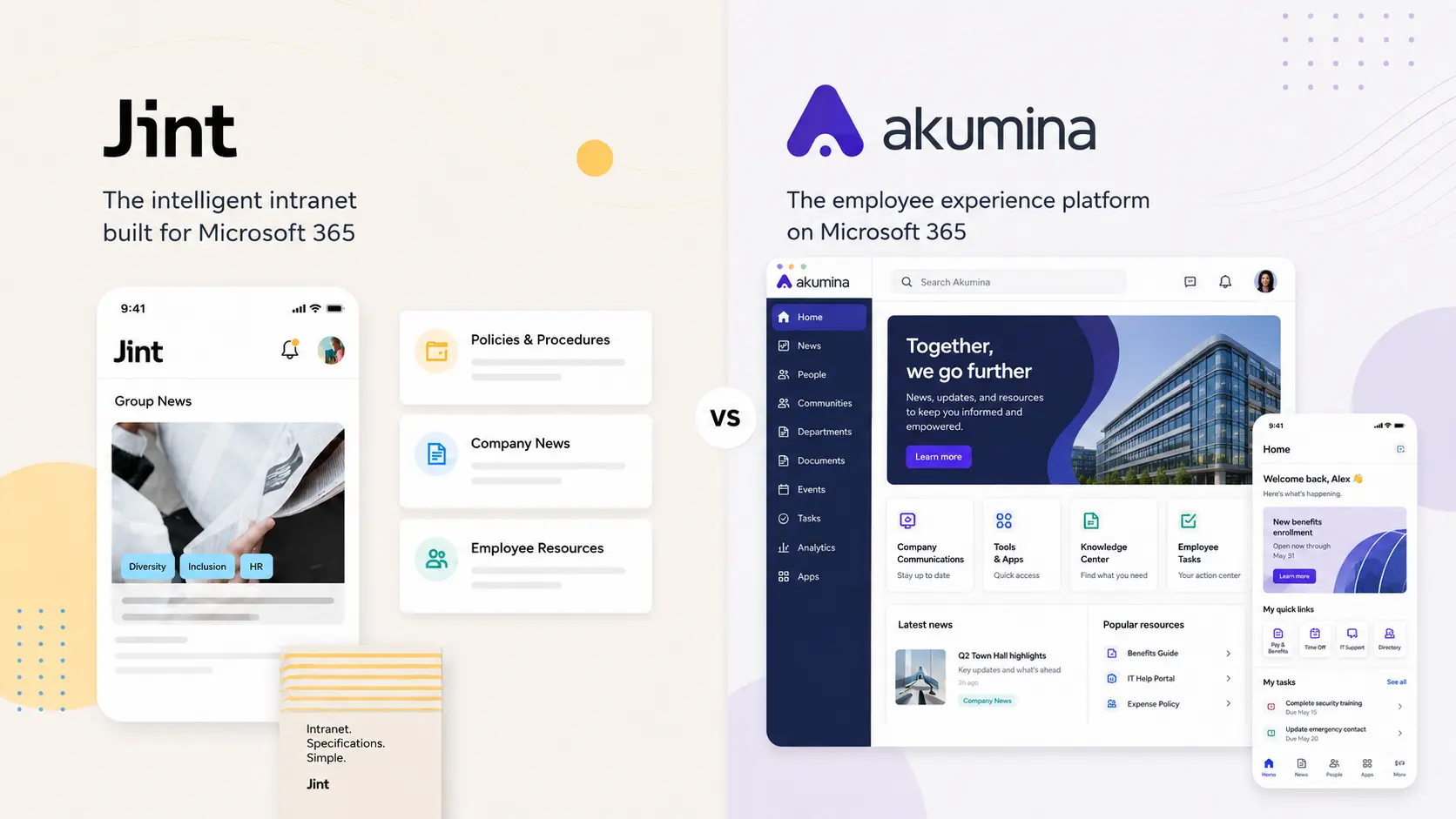


If your company runs on Microsoft 365, both Jint and Akumina build on it, but at very different weights. Akumina is an enterprise employee experience platform layered on top of Microsoft 365 and SharePoint. Jint is a native add-in that enhances the SharePoint and Teams you already own, and extends them with a full product suite, without a heavy implementation program.
According to McKinsey, employees spend on average 1.8 hours a day searching for information. A good intranet gives that day back. With both products on Microsoft 365, the real questions are how heavy the platform is to stand up, and how much value you get for the investment.
What Akumina does well
Akumina is a serious enterprise EXP, with a large community of daily users. Reviewers (Gartner Peer Insights, G2) praise strong personalization, useful analytics, multilingual support and the ability to scale to very large, global organizations. Its App Manager lets teams extend the environment without a full developer. For big enterprises with the resources to run it, Akumina delivers.
The real limits of Akumina
The recurring caveat in reviews is weight. Akumina is "a significant investment in both cost and time," and its extensive feature set can be overkill for organizations with limited IT resources. One reviewer notes that while teams get good guidance on what could be done, "actually putting it into place takes a long time." For a mid-market company, that is a lot of platform to fund and maintain.
Where Jint is different
Jint is right-sized. As a native Microsoft 365 add-in and official Microsoft partner solution, it goes live in weeks, not quarters, with self-service customization on SharePoint and your data 100% in your own tenant. And it is more than an intranet: Jint Mobile reaches frontline teams, Jint Newsletter handles internal comms, Jint Translator covers 100+ languages, and Jint Genius brings AI grounded in your M365 content. You get enterprise capability without the enterprise implementation tax.
Jint in brief
Jint (formerly Mozzaik365) is built by a 50+ team across Paris and Montreal, with 8 years of Microsoft 365 expertise, 300+ clients and over a million active users. It turns native SharePoint into a modern intranet, and goes beyond the intranet with four products: Jint Mobile, Jint Newsletter, Jint Translator and the Jint Genius AI assistants. On Capterra it scores 4.7 out of 5 (as Mozzaik365), with an 86% recommendation rate on G2. Your data stays in your own Microsoft 365 tenant.
Jint vs Akumina: side by side
If you're comparing multiple intranet platforms, check out our full intranet software comparison for 2026.
When to choose Akumina, when to choose Jint
Choose Akumina if you are a large enterprise with a dedicated team and budget for a full EXP program. Choose Jint if you want enterprise-grade capability that deploys fast and stays light to run, on the Microsoft 365 you already own, with a full product suite and data in your tenant. See our wider alternative to SharePoint comparison.
AI: a structured intranet is the foundation, not a feature
An AI agent is only as good as the information it can reach. Point one at scattered or poorly governed content and it hallucinates or finds nothing. A well-structured intranet on Microsoft 365 organizes, updates and governs your knowledge, exactly what an agent needs to answer correctly. Jint Genius builds on that foundation instead of bolting an assistant onto chaos.
The bottom line
Akumina is a powerful enterprise EXP, but a heavy one. For most Microsoft 365 companies, Jint delivers the experience, the mobile reach, the newsletters and the AI inside the M365 you already own, faster to deploy and lighter to maintain.
Book a Jint demo to see it on your own SharePoint.