.webp)

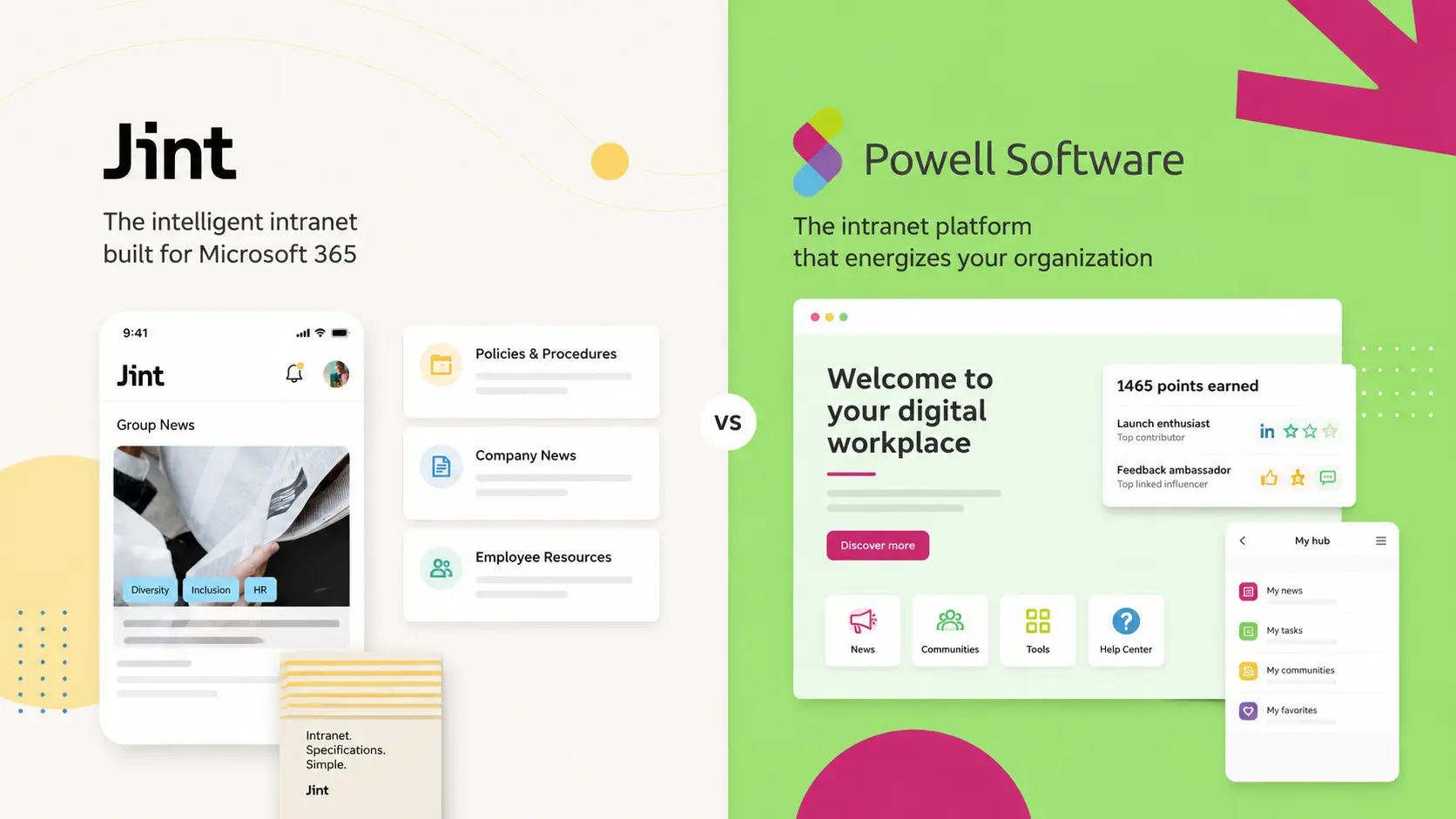


If your company runs on Microsoft 365, both Jint and Powell build on it, but not in the same way. Powell relies on connectors and webviews and stores some data on its own side. Jint is 100% native: it enhances SharePoint, Teams and Viva directly, and 100% of your data stays in your own tenant.
According to McKinsey, employees spend on average 1.8 hours a day searching for information. A good intranet gives that day back. With both products on Microsoft 365, the real questions are how native the integration is, where your data lives, and how much you depend on the vendor.
What Powell does well
Powell is an established Microsoft 365-based intranet and digital workplace, with a broad feature set and a track record with large organizations. For teams that want a packaged digital workplace on M365 and are comfortable with a connector-based architecture, it is a credible option.
Where Jint is different
The gap is architecture. Powell uses connectors and webviews, with mixed data storage across the M365 cloud and Powell, and components that can need specific training and vendor involvement to customize. Jint is a native add-in: components run inside SharePoint and Teams, data stays 100% in your tenant, and your team customizes pages and layouts in self-service, no support ticket required. Microsoft maintains the infrastructure; Jint pushes product and AI evolutions on top.
Jint in brief
Jint (formerly Mozzaik365) is built by a 50+ team across Paris and Montreal, with 8 years of Microsoft 365 expertise, 300+ clients and over a million active users. It turns native SharePoint into a modern intranet, with a personalized news hub, advanced search, an employee directory, onboarding journeys and a mobile experience for frontline workers. On Capterra it scores 4.7 out of 5 (as Mozzaik365), with an 86% recommendation rate on G2. Your data stays in your own Microsoft 365 tenant.
Jint vs Powell: side by side
If you're comparing multiple intranet platforms, check out our full intranet software comparison for 2026.
When to choose Powell, when to choose Jint
Choose Powell if a connector-based packaged digital workplace fits your needs and governance. Choose Jint if you want a 100% native experience, 100% of your data in your own tenant, and full self-service autonomy on Microsoft 365. See our wider alternative to SharePoint comparison.
AI: a structured intranet is the foundation, not a feature
Everyone ships an AI assistant now. The uncomfortable truth: an AI agent is only as good as the information it can reach. Point one at scattered or poorly governed content and it hallucinates or finds nothing. So the order matters. A well-structured intranet on Microsoft 365 organizes, updates and governs your knowledge, exactly what an agent needs to answer correctly. Jint Genius builds on that foundation instead of bolting an assistant onto chaos.
The bottom line
Both run on Microsoft 365, but Jint is native where Powell connects. For full data sovereignty in your tenant, native performance and team autonomy, Jint is the more direct, lower-maintenance choice.
Book a Jint demo to see it on your own SharePoint.