





One number sets the scene. According to McKinsey, employees spend an average of 1.8 hours a day, 9.3 hours a week, searching for and gathering information. That is nearly a full workday every week, lost chasing information that should be one click away. The problem has not gone away: Microsoft's 2024 Work Trend Index found that 68% of employees say they lack enough uninterrupted focus time. And when communication truly breaks down, the bill is steep. Grammarly and The Harris Poll estimate poor communication costs U.S. businesses around $1.2 trillion a year.
What is internal communication?
Internal communication is the set of communication actions aimed at the people inside an organization. It covers official messages (leadership announcements, company updates, the internal newsletter) and the informal exchanges of daily work (team chats, instant messaging, the enterprise social network).
Its mission fits in one line: get the right information to the right person, at the right time, through the right channel. Behind that apparent simplicity sits a real discipline, owned depending on the company by the internal communications team, HR, or both together. In larger organizations, internal communications leaders run it as a function in its own right.
Do not confuse it with external communication, which targets customers, partners and the public. The two are complementary: a company that gets its internal voice right projects a coherent image outside. We unpack that link in our piece on the synergy between internal and external communication.
The 3 types of internal communication
Three complementary directions structure how information flows through an organization.
- Top-down communication: from leadership to teams. It carries vision, decisions, guidance and results. It is the most common, and often the only one when a company starts out.
- Bottom-up communication: from employees to management. Field feedback, ideas, alerts, surveys. This is what turns a monologue into a dialogue.
- Horizontal communication: peer to peer, across teams, without hierarchy. It fuels collaboration and breaks down silos.
A mature internal communication practice keeps all three alive. Top-down informs, bottom-up listens, horizontal connects. For the detail of each flow with concrete examples, we wrote a full article on the 3 types of internal communication.
Why internal communication is a performance issue
Here is the part too many articles skim. Internal communication is not a comfort: it weighs directly on productivity, engagement and retention. The numbers are blunt.
On cost first. According to the State of Business Communication study by Grammarly and The Harris Poll (2022), poor communication costs U.S. businesses around $1.2 trillion a year, close to $12,506 per employee. In the same survey, 72% of leaders said their teams had run into communication problems over the year.
On business next. The 2024 edition of the same study shows employees now spend up to 88% of their workweek communicating, and that one leader in five says they have already lost a deal because of poor communication. When information flows badly, it is not just nerves that fray: projects slip and sales evaporate.
On engagement finally. According to Gallup (State of the Global Workplace, 2024), the most engaged teams are about 23% more profitable than the least engaged. Engagement feeds on information: people who understand where their company is going, and why, get more involved. Silence, by contrast, feeds rumor, disengagement and churn.
So the real question is not whether to communicate. It is how to stop internal communication from becoming a hidden cost. We covered the symptoms and the fixes in our article on poor internal communication and its consequences.
Internal communication tools
A message is only as good as the channel that carries it. Internal communication tools fall into three families that you combine rather than oppose.
- Editorial tools: internal newsletter, company news, digital signage. Ideal for regular, top-down messages that need some shaping. The internal newsletter remains one of the most effective formats to inform without drowning people.
- Conversational tools: instant messaging, enterprise social network, discussion spaces. They smooth the bottom-up and horizontal flows, and take pressure off the inbox.
- The layer that unites them, the intranet. It centralizes reference information, hosts content, organizes access and connects the other tools. An intranet built for communication prevents fragmentation and gives teams a single entry point.
The right tool depends less on the format than on the problem to solve: inform, listen, collaborate, or structure information for the long run. Here is which channel to favor by need.
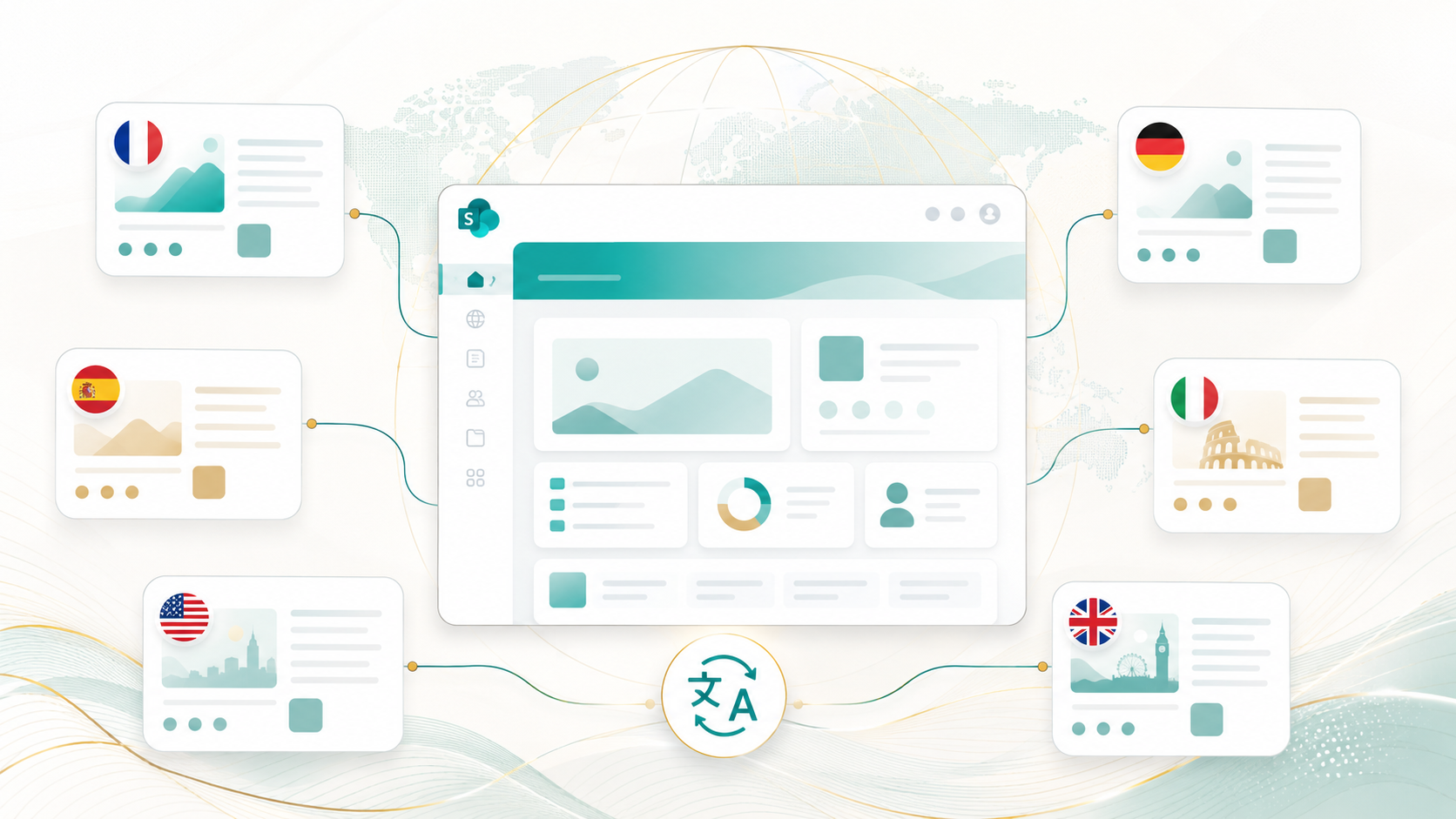
Concretely, on Microsoft 365 these families map to SharePoint (portal and document base), Microsoft Teams (day-to-day exchanges) and Viva Engage (the internal social network). A solution like Jint unites them in a native, personalized experience, instead of leaving them scattered across tools that ignore each other.
The choice is made by use, not by tool. To compare market solutions and their use cases, see our comparison of internal communication tools.
How to build an internal communication strategy
Good internal communication is not improvised, it is steered. Here is a six-step method that works at any company size.
- Audit what exists. Which channels do you already use, and which actually work? Cross usage data (open rates, intranet traffic) with field feedback (survey, interviews). You do not build in the dark.
- Set SMART goals. Specific, measurable, attainable, realistic, time-bound. "Improve communication" is not a goal. "Raise newsletter read rate from 40% to 60% in six months" is.
- Map your audiences. A head office and frontline teams do not communicate the same way. Segment, and match message and channel to each population.
- Write the communication plan. Messages, targets, channels, editorial calendar, budget, indicators. This is the backbone.
- Pick the right channels. Aligned with real usage, not with leadership habits. A message for frontline workers does not live in an email.
- Measure and adjust. Engagement, readership, participation, retention: track a few key indicators and course-correct continuously.
To move from method to ideas, browse our 10 strategies to succeed at internal communications and our examples of strategies and campaigns.
Concrete examples of internal communication
Theory lands better with real cases. Here are internal communication actions that work, from the everyday to the big moments.
- A monthly leadership newsletter to explain priorities and give context.
- A flash survey right after a major announcement, to gauge understanding and sentiment.
- An onboarding campaign that supports every new hire through their first weeks.
- A dedicated field-feedback channel for frontline teams, to keep the bottom-up alive.
- A reference intranet page on HR or IT changes, kept current.
- A short video from the CEO to give meaning to a strategic decision.
For broader inspiration, see our 10 examples of internal communication in a company.
Internal communication and AI: why the foundation matters more than ever
Microsoft Copilot and AI assistants change the game, but not in the way most expect. The temptation is to believe AI will fix internal communication on its own. The opposite is true.
An AI agent is only as good as the information it can reach. Plug an assistant into scattered, outdated or poorly governed data, and it will hallucinate, surface stale content, or find nothing. Plug it into a structured, up-to-date, well-governed intranet, and it becomes a powerful accelerator.
In other words, the intranet is not AI's competitor, it is its foundation. Before deploying agents, you put the house in order: organize knowledge, clarify the sources of truth, keep content current. That is exactly what a well-built intranet on Microsoft 365 does, and it is the base on which assistants like Jint Genius can answer accurately. The internal communication of tomorrow rides less on the broadcast tool than on the strength of the foundation that feeds it. To go further, see how to turn an intranet into a digital workplace.
Benefits and limits of an intranet for internal communication
Let us be straight: deploying an intranet to carry internal communication has a real cost and real risks. Here they are, no spin, and how an integrated solution neutralizes each.
The message is simple: the danger is not the intranet, it is the custom intranet you have to maintain by hand. The right intranet is not one more portal: it is an orchestration layer that builds on the tools you already use, notably Microsoft 365, to structure information, measure engagement and prepare for AI. That is exactly Jint's approach. For the business benefits, see the benefits of a company intranet.
Best practices for internal communication that engages
Beyond tools, a few reflexes separate communication people endure from communication people follow.
- Care about formats. Short videos, infographics, an internal podcast: a well-shaped message gets read and remembered, where a wall of text gets ignored.
- Pace the frequency. Enough to inform, not so much that people tune out. Segment, and send each message only to the relevant audience.
- Involve managers. They are the first relays. Clarify what is expected of them and equip them, because a manager who communicates well pulls the team along.
- Measure continuously. Read rates, participation, intranet engagement: track a few indicators and adjust.
Case studies: two companies that transformed their internal communication
Theory holds up in the field. Two concrete examples, one an SME, the other a multinational.
Armonia: fewer emails, more engagement with SharePoint and Jint
Armonia, a major Facility Management player (12,000 employees), suffered from fragmented internal communication: without a centralized intranet, information scattered, email overloaded, engagement dropped. By deploying a unified SharePoint intranet enriched with Jint, the company centralized its communications and targeted its messages. The results: 500 permanent employees logging in daily, 80% fewer internal emails, and internal content consultation doubled. See the Armonia case study.
Coca-Cola: a stronger culture through an internal podcast
Coca-Cola (700,000 employees) needed to align its teams with leadership's strategic direction. The North American division launched an internal podcast in 2019, "Total Refresh," where two employees interviewed executives about managing change. By using a format employees enjoy and creating direct dialogue between staff and leadership, the company broke away from rigid top-down communication and reinforced its culture around shared stories.
What to remember
Internal communication is a performance driver, not a comfort expense. It runs on three flows (top-down, bottom-up, horizontal), deploys through three tool families united by the intranet, and is steered in six steps from audit to measurement. Its new frontier is AI: a structured intranet conditions the quality of answers from assistants like Copilot. Put the foundation in order, and the rest follows. Want to make your intranet the engine of your internal communication? Discover Jint and book a demo.


.webp)


.jpg)


