





Employee engagement isn't just about recognition and management
We've already covered what employee engagement is and how to measure it: recognition, frontline management, company culture, internal communication. These classic levers still matter. But they share a blind spot: they assume information and tools are already easy to reach.
In reality, across many organizations, an employee spends a meaningful chunk of the day hunting for a document, chasing a colleague for information they should have found on their own, or switching between five different apps to complete one simple task. No recognition program offsets that friction. It just wears people down. That blind spot, the employee portal, is what this article digs into.
The overlooked lever: the everyday employee portal
According to McKinsey's "The social economy" research, employees spend an average of 1.8 hours a day, close to 9.3 hours a week, searching for and gathering information. That's nearly a full working day every week lost to searching instead of doing meaningful work. This friction hits engagement directly: an employee who loses time every day looking for what should be one click away eventually disengages, even if they genuinely like the job.
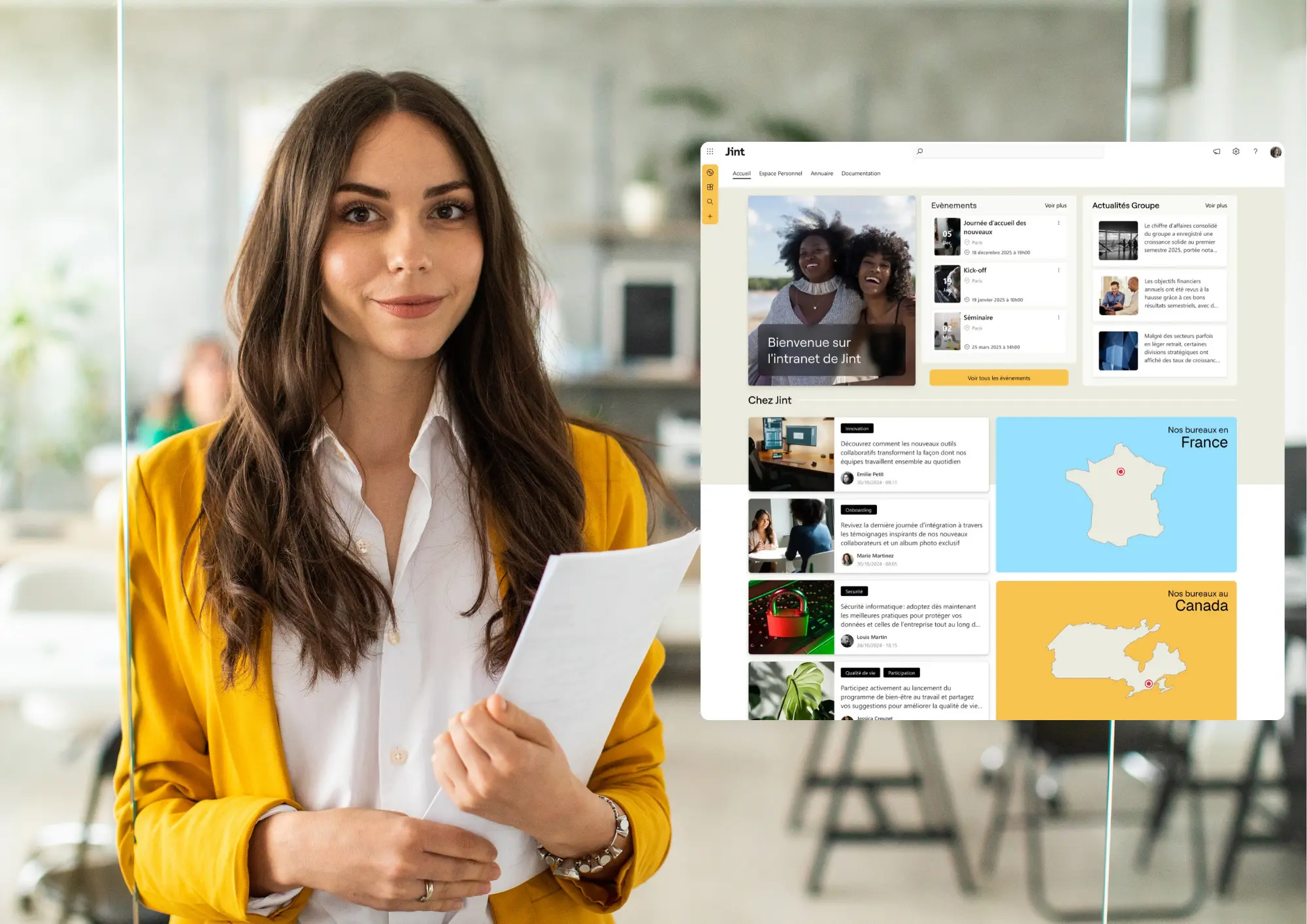
This is where the employee portal comes in. A well-structured intranet isn't just a news feed: it's the single access point to information, business tools, the company directory, HR requests, and peer recognition. When that access point works, it removes friction from the day. And removing friction is one of the most concrete ways to move engagement, far more than a slogan painted on a wall.
This is the thesis Jint has defended for years: a smooth, well-designed digital workplace changes daily life and accelerates performance. The intranet isn't just another communication channel. It's the infrastructure the employee experience runs on.
What a well-designed employee portal actually changes
Instant access to information and tools
A good employee portal centralizes the directory, HR documents, business tools, and news in a single entry point connected to Microsoft 365. In practice, an employee finds their pay slip, the remote-work policy, or the right contact without opening five tabs. That simplicity, invisible when it works, is exactly what builds trust in the tool, and therefore adoption.
Internal communication and recognition built in
The portal also becomes the place where peer recognition flows, where team wins are visible, where a targeted internal newsletter reaches the right audience instead of blasting everyone. According to PostBeyond, a message relayed by employees themselves reaches up to 561% more people than the same message shared only through branded channels. A portal that makes that relay easy turns every employee into a potential advocate.
A visible sense of belonging and culture
Company culture doesn't live in a PDF charter forgotten on a server. It lives in spaces where teams recognize each other, where new hires quickly understand who does what, where HR leaders can run onboarding without technical complexity. A well-designed portal makes that culture tangible every day, not just at the annual kickoff.
Measuring engagement through real usage
Unlike an annual survey, an employee portal gives a continuous read on engagement: login rates, participation in internal polls, interaction with news posts. It's a real-time gauge, far more responsive than a once-a-year HR questionnaire.
Native SharePoint portal vs. enriched employee portal: the real impact on engagement
Many organizations already have SharePoint through their Microsoft 365 subscription, yet don't use it to drive engagement. The gap between a native SharePoint intranet and an enriched employee portal comes down to the experience teams actually live day to day.
None of this argues against SharePoint. It's a solid, well-documented foundation, and Jint builds on it rather than replacing it. If your organization hasn't laid that technical groundwork yet, building a SharePoint intranet is still the first step. What changes engagement is what you build on top.
How Jint turns a SharePoint intranet into an engaging employee portal
At Jint, engagement is treated as much as an access problem as a management one. Jint SharePoint enriches your existing Microsoft 365 foundation with a premium experience, built so every employee finds what they need in seconds, without piling another tool onto an already crowded stack.
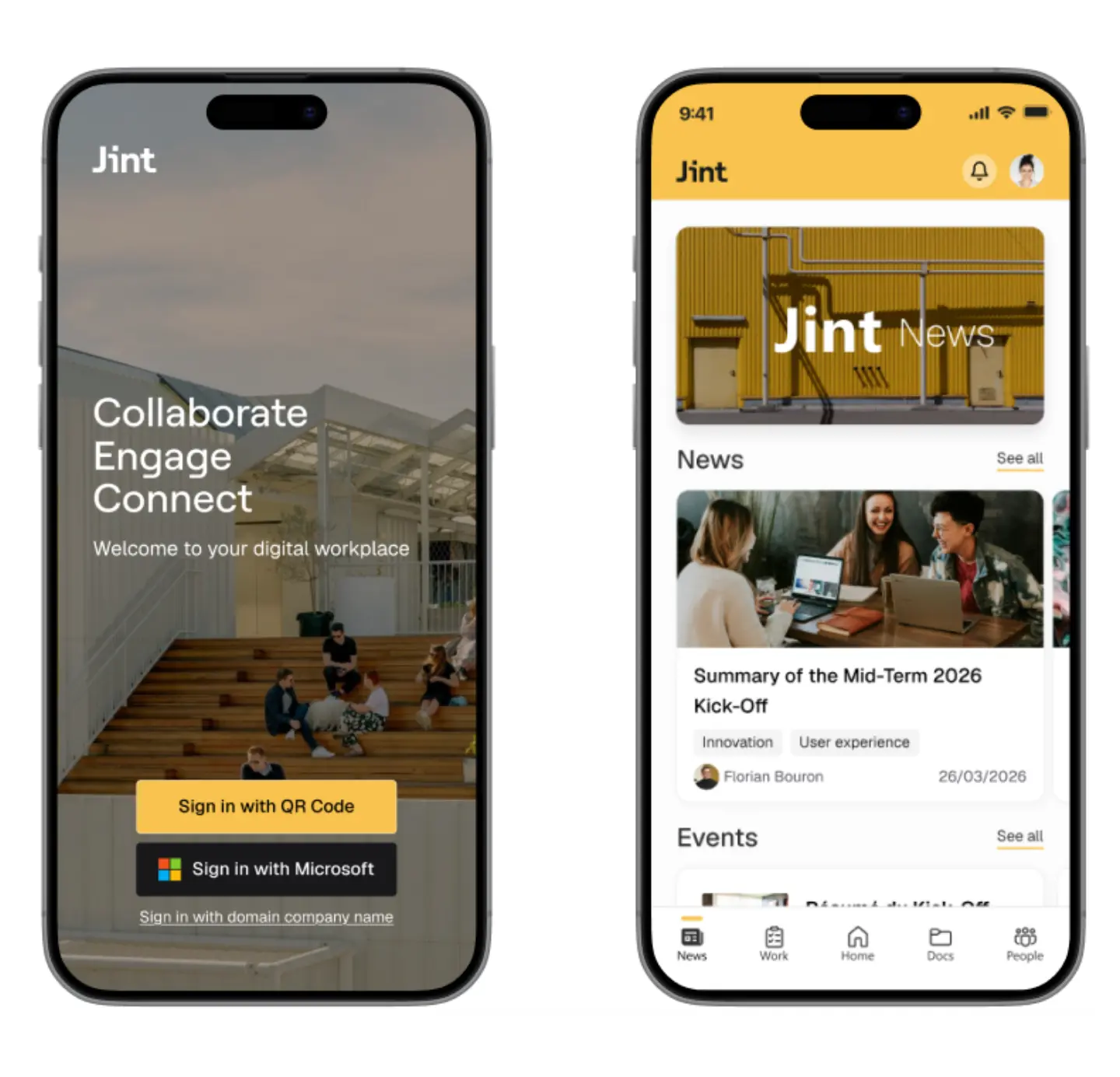
For frontline teams, often the forgotten audience of classic intranet projects, Jint Mobile brings the employee portal straight to the phone, with targeted push notifications that finally reach desk-less employees. And to give everyone direct access to company knowledge, without depending on a colleague or an outside search engine, Jint AI builds on that same structured foundation to answer everyday questions, provided the underlying intranet is itself well governed.
One thing worth flagging: adding yet another tool to an already saturated stack is expensive in adoption terms. That's why Jint doesn't add a new channel. It enriches SharePoint and Teams natively: teams keep their habits, the experience gains depth.
Checklist: 6 levers to activate engagement through your employee portal
- Audit how much time your organization actually loses searching for information, even informally (interviews, a quick pulse survey).
- Centralize the most-used tools and documents into a single access point, connected to Microsoft 365.
- Build in peer recognition directly inside the portal, not as one more separate tool.
- Extend access to frontline teams through a dedicated mobile app, instead of leaving them out of the intranet project.
- Measure engagement through real portal usage (logins, interactions), alongside the annual HR survey.
- Hand off maintenance to a SaaS solution that stays current automatically, so your team's energy goes into usage, not upkeep.
An employee portal that truly engages people isn't a project you launch once and forget. It's a living space that evolves with how your teams actually work. If employee engagement is a priority for your organization, the first question isn't "what bonus, what offsite?" It's simpler: do your people easily find what they need, every single day?

.webp)


