




🧠 TL;DR: The intranet chatbot, the short version
- A chatbot isn't a separate tool you shop for. It's a feature of your digital workplace, built on the same content your intranet already organizes.
- Ask it something outside that content, and it invents an answer. Ask it something well organized, and it answers instantly, and right.
- In practice, it shows up in three places: your intranet's search, your HR hub, and onboarding.
- Gartner predicts more than 40% of agentic AI projects will be canceled by 2027, over cost, unclear value, or weak risk controls.
- Jint AI wires the chatbot straight into your SharePoint intranet, no custom build required. See Jint AI.
What is a digital workplace, and where does the chatbot fit in?
A digital workplace is the organized hub where a company keeps its content, its tools, and its people: HR policies, project spaces, the employee directory, internal news, search. A well-built one, like a Microsoft 365 intranet, structures all of that so people, and increasingly software, can find it.
The chatbot is one layer sitting on top of that hub. It isn't a separate destination. Behind the conversation sits a large language model (LLM) that turns a question into a natural-language answer, and a retrieval mechanism, RAG (retrieval-augmented generation), that goes and searches your intranet's content before answering. Strip out the retrieval part, and the chatbot is guessing from public training data. Keep it, and it becomes a real SharePoint knowledge agent: it reads the same HR policy, the same product sheet, the same project page your intranet already indexes.
That's the shift worth understanding: the chatbot doesn't replace your digital workplace. It reads it.
Why conversational AI is moving to the center of the digital workplace in 2026
Microsoft's 2025 Work Trend Index found that employees are interrupted, on average, every two minutes: a meeting, a notification, an email. A digital workplace that takes five separate searches to answer one question doesn't help.
McKinsey's "The Social Economy" report put a number on that cost: 1.8 hours a day, 9.3 hours a week, spent searching for and gathering information. Close to a full workday, every week, lost navigating a digital workplace instead of using it. The figure is dated, but tool sprawl has only made the underlying problem worse since.
A chatbot embedded in the digital workplace promises to collapse that search into one question, asked in plain language. That's why teams focused on employee experience are paying attention: an assistant that answers correctly, instantly, from inside the tools people already use, changes the daily experience for frontline and desk workers alike. But it only holds if the answer is right. An intranet chatbot that answers fast and wrong costs more than it saves: someone still has to double-check it, and trust erodes fast once it's caught inventing an answer.
The real foundation: the quality of your intranet's content
At Jint, the thesis is simple: a chatbot embedded in your digital workplace is only as good as the content that workplace organizes. Scattered, outdated, or ungoverned content, and the chatbot hallucinates, surfaces a stale version, or finds nothing at all.
Gartner makes the point indirectly. In a June 25, 2025 press release, the firm predicted that more than 40% of agentic AI projects will be canceled by the end of 2027, citing escalating costs, unclear business value, and inadequate risk controls. Gartner doesn't name ungoverned content as the headline cause, but the three reasons share a root: a project launched on a workplace that wasn't ready for it. Without a clear knowledge management strategy, there's no way to measure what a chatbot produces, or control what it exposes.
This is what an AI-ready digital workplace actually means in practice: not a chatbot bolted on top, but content that's current, categorized, and governed underneath it. The chatbot isn't competing with your intranet. It's built on it.
Where the chatbot actually shows up in your digital workplace
In practice, an intranet chatbot rarely lives in its own app. It surfaces inside the digital workplace modules people already use, every day:
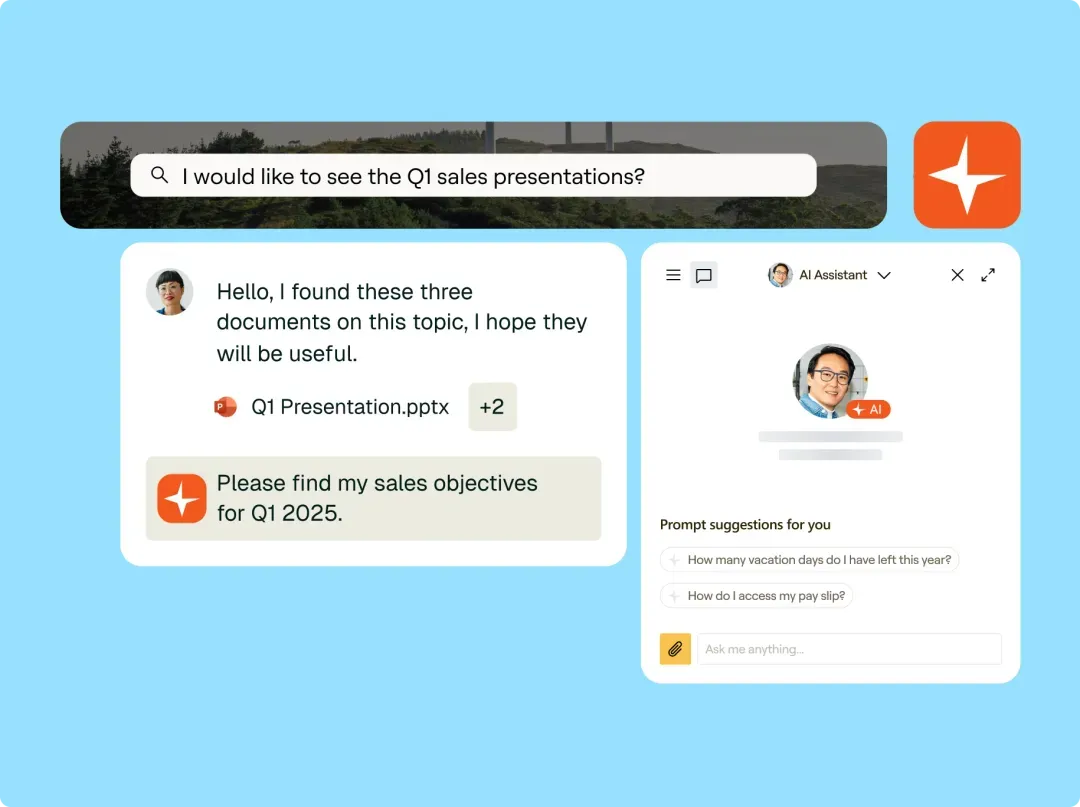
- In search. Instead of scrolling through SharePoint folders, someone types a question and gets a direct answer, sourced from the document that contains it.
- In the HR hub. A leave policy, a benefits question, an onboarding step, answered from your current HR pages instead of an outdated PDF someone bookmarked years ago.
- In onboarding. A new hire asks where to find a template or who owns a project, and gets pointed to the right intranet page instead of pinging five people on Teams.
- In news and knowledge bases. Summarizing a long policy update, or resurfacing the guide that already answers a recurring support question.
Each of these use cases pulls from a different part of your intranet, which is exactly why a fragmented digital workplace produces a fragmented chatbot: sharp on HR, wrong on IT support, because the two live on content with very different levels of upkeep.
Generic AI chatbot vs. a chatbot built into your intranet
Not every chatbot inside the digital workplace is built the same. The difference isn't the chat interface. It's what sits behind it, and how deeply it's wired into your intranet.
A generic AI chatbot, the consumer-grade kind trained on the open web, answers from general knowledge: sometimes outdated, never specific to your workplace. A chatbot built into your intranet answers from your documents, your processes, your current content, respecting the access rights your intranet already enforces. The same generative AI layer sits underneath both, so the gap comes entirely from what it's connected to.
The takeaway: a generic AI chatbot is a fine copilot for generic tasks, rewriting a paragraph, summarizing a public article. To answer questions about your workplace, it needs to be wired into it. That's the role a chatbot built into your intranet plays.
Security and governance: what your intranet must guarantee first
A chatbot embedded in your digital workplace touches whatever that workplace touches: contracts, salaries, HR files, customer records. Before adding one, your intranet needs to guarantee three things.
Where the content lives: inside your own Microsoft 365 tenant, under your control, not on a third-party server. Certification: a recognized security standard like ISO 27001, which governs how information risk is managed. Access rights: the chatbot can only be as careful as the permissions already layered onto your intranet. A poorly scoped chatbot surfaces whatever it can technically reach, whether the person asking should see it or not.
This is the part most digital workplaces get wrong first. Years of shared drives and loosely managed SharePoint sites leave behind permissions nobody remembers granting. Plug a chatbot into that mess, and it will happily surface all of it. A cleanup pass on access rights, before you add a chatbot, is cheaper than explaining an exposure after the fact.
This goes beyond the chatbot itself. Our cybersecurity best practices for employees and review of Microsoft Security Copilot dig deeper into this. The core rule: a chatbot in your digital workplace deserves the same security scrutiny as any tool that touches sensitive data, not the treatment of a novelty gadget.
How Jint AI brings the chatbot into your Microsoft 365 intranet
Building a chatbot in-house, with its own retrieval pipeline and its own security layer, takes months and a dedicated data team most digital workplaces don't have. The faster path: add a chatbot that's already built to read a Microsoft 365 intranet.
That's what Jint AI (formerly Jint Genius) does. We laid the groundwork when we first launched our generative AI: connect the chatbot directly to the digital workplace, no custom build required. In practice, the platform covers:
- Adaptive RAG pipelines that pull current information straight from your SharePoint.
- Module-specific AI assistants: one for HR, one for support, one for sales, each drawing on its own part of the intranet.
- AI-powered search built directly into your intranet, for finding a document in plain language.
- A writing assistant that drafts, translates, and refines content based on your internal data.
- Multi-module configuration, so each assistant is tuned to a specific part of the digital workplace rather than one generic bot trying to do everything.
More than a million active users already rely on Jint's products worldwide, with over 100 five-star reviews on G2 and Capterra. The principle stays the same for any serious AI project: start with the workplace, not the interface.
The chatbot, one more building block of a structured digital workplace
A chatbot isn't a standalone project sitting apart from your digital workplace. It's the conversational layer on top of your structured Microsoft 365 intranet. The more organized, current, and governed your content, the better it answers.
Priorities matter here. Before rolling one out, get the house in order: classify, update, govern. That behind-the-scenes work, invisible but decisive, is what separates a chatbot that impresses in a demo from one employees actually use, week after week, wherever they already work. It's also what shows up in Microsoft's own take on generative AI in the digital workplace: the companies getting the most value from AI are the ones that had already organized their information before adopting it.
Curious what this looks like inside your own digital workplace? Request a Jint AI demo.
.webp)


